
Cómo cubren las familias la brecha mensual en vida asistida: las seis puertas
Divide la factura mensual de vida asistida o memoria en tres rubros (Alojamiento, Cuidado Personal y Atención Clínica) para acceder a las Seis Puertas de Financiamiento: Seguro Social, Seguro de Cuidado a Largo Plazo, VA Aid & Attendance (hasta $2,874/mes en efectivo libre de impuestos), exenciones HCBS de Medicaid, patrimonio de la vivienda y deducción médica según el Art.
Este episodio en inglés utiliza voces generadas con IA. El guion fue investigado, redactado y verificado por el equipo editorial de families.care con fuentes oficiales de CMS, VA y Seguro Social.
Leer guía escrita complementaria (EN) →
Cómo cubren las familias la brecha mensual en vida asistida: las seis puertas
Escuche abajo en inglés con subtítulos o salte directamente a cualquier capítulo.
Saltar a capítulo (toque la marca de tiempo para ir al audio y actualizar enlace #t=):
Puntos clave
- 01Divida toda cotización en 3 rubros: Rubro 1 (Alojamiento y comidas), Rubro 2 (Cuidado personal y supervisión) y Rubro 3 (Atención médica y recetas).
- 02La ley federal prohíbe que las exenciones HCBS de Medicaid paguen Alojamiento (Rubro 1); el Seguro Social cubre el alojamiento mientras la exención cubre el cuidado personal (Rubro 2).
- 03Puerta 1 (Ingreso fijo): El beneficio promedio del Seguro Social 2026 es de $2,071/mes (+3.6% COLA para 2027).
- 04Puerta 2 (Seguro de cuidado a largo plazo): Requiere 2 de 6 actividades diarias (ADL) o deterioro cognitivo grave; inicie el reclamo el Día 1 para activar el período de eliminación.
- 05Puerta 3 (VA Aid & Attendance): Tarifa máxima 2026 de hasta $2,424/mes (veterano soltero), $2,874/mes (casado) o $1,558/mes (cónyuge sobreviviente) en efectivo exento de impuestos.
- 06Puertas 4–6 (Exenciones Medicaid, capital de la vivienda y deducciones fiscales): Tope de ingresos 2026 de $2,982/mes (300% SSI); pregunte por escrito si exigen 12–24 meses de pago privado y consulte el Art. 213(d) del IRS.
Calculadora de brecha mensual de $6,200 y combinación de beneficios
Divida la factura en Alojamiento (Categoría 1) y Cuidado Personal (Categoría 2) para calcular cuánto cubren el Seguro Social, VA Aid & Attendance, el seguro LTC y las exenciones de Medicaid.
Brecha mensual neta familiar (tras beneficios)
$4,129/mo
Factura total: $6,200/mes · Cubierto: $2,071/mes
Puente de espera de 90 días (eliminación / VA)
$12,387
Ritmo en casa ($3,120/mes) ahorra $9,240 en 90 días
Desembolso familiar a 24 meses
$99,096
Categoría 3 (médica + Rx tope $2,400) en Medicare
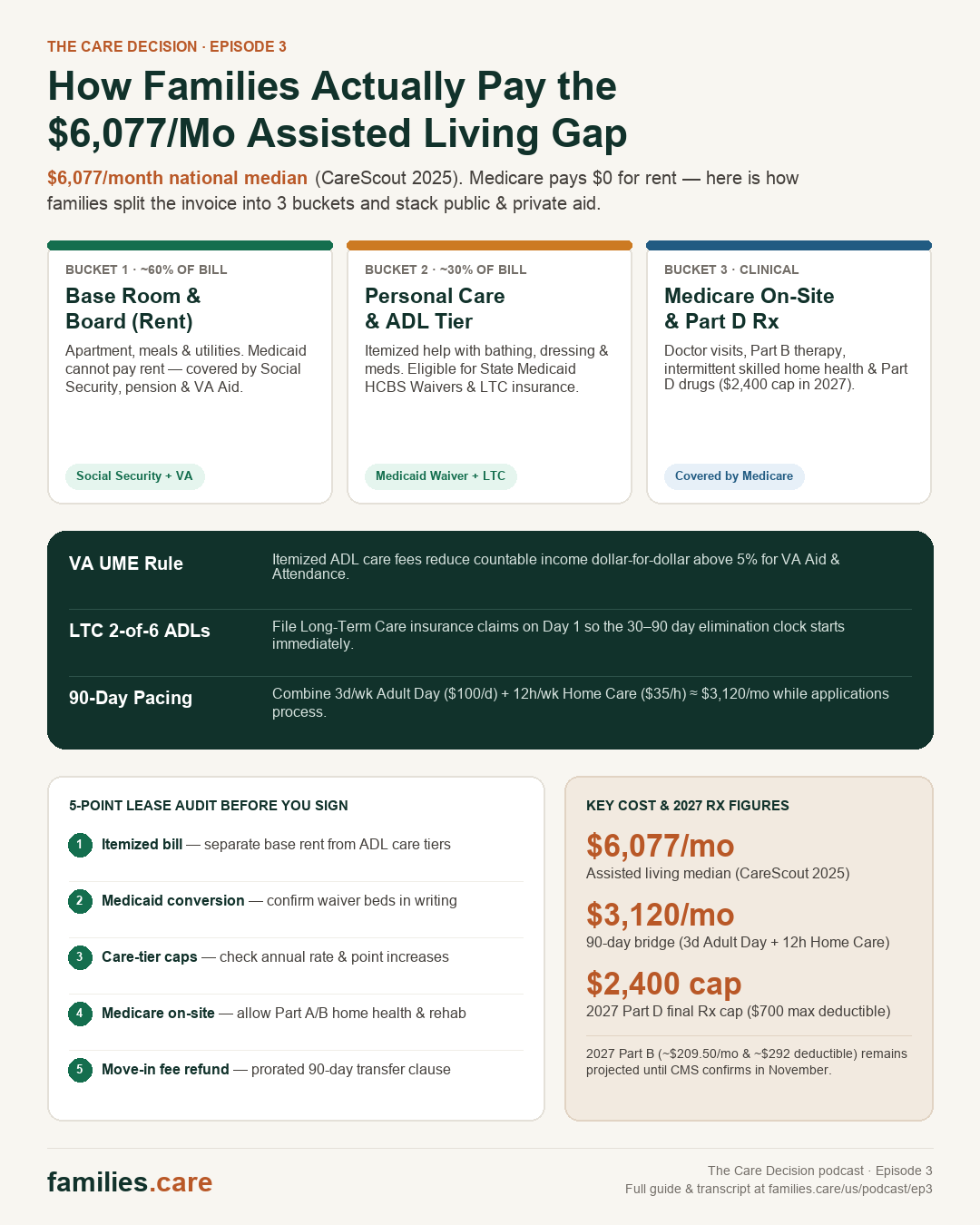
Tarjetas de referencia imprimibles del Episodio 3
Diseñadas para llamadas con aseguradoras, recorridos por residencias y reuniones familiares. Las láminas visuales están en inglés con cifras oficiales verificadas.
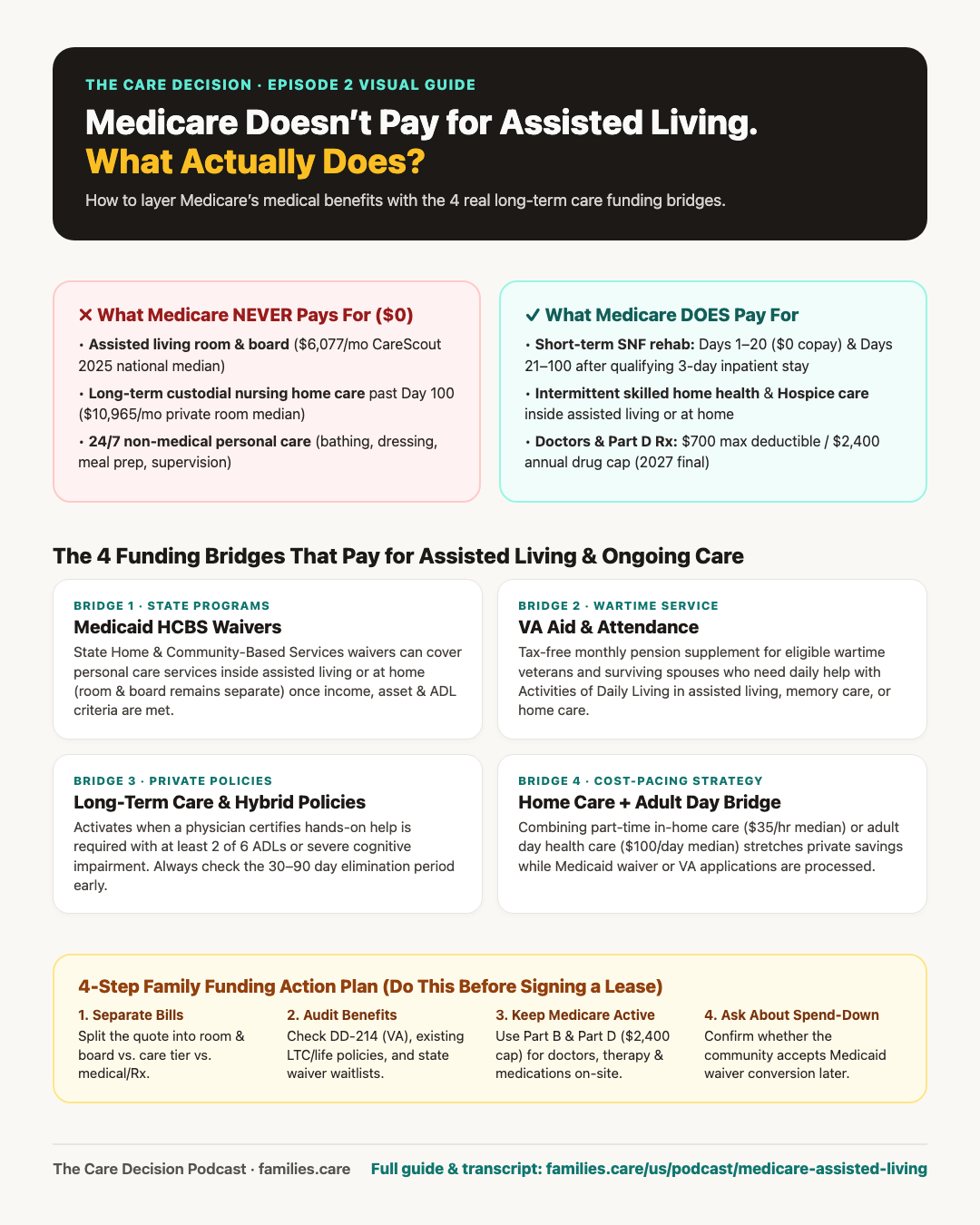
Notas del episodio
If the national median for assisted living is $6,200 a month and the average retired worker's Social Security check in 2026 is $2,071 a month, there is a $4,000+ monthly gap appearing on the kitchen table every 30 days. In Episode 3, Maya and Daniel explain why no single program pays the whole invoice — and how splitting your community's quote into 3 separate legal buckets (Bucket 1: Room & Board, Bucket 2: Personal Care Tier, Bucket 3: Medical & Clinical Care) unlocks the Six Funding Doors: (1) Social Security & pensions (including the 3.6% 2027 COLA), (2) Long-Term Care Insurance (2-of-6 ADL triggers & 90-day elimination clocks), (3) VA Aid & Attendance tax-free cash ($1,558–$2,874/mo), (4) State Medicaid HCBS Assisted Living Waivers (why Medicaid never pays Room & Board and why 12–24 month private-pay rules matter), (5) Home equity & bridge financing, and (6) Life settlements & the IRS Sec. 213(d) medical expense deduction.
Enlaces mencionados en este episodio
Transcripción completa (guion original en inglés)
Guion íntegro de producción reproducido textualmente tal como fue grabado en inglés.
📖 Leer diálogo completo de Maya y Daniel (34 intervenciones) Expandir ↓
Maya: A quick note before we begin. This episode uses A I generated voices. The script was researched, written, and fact checked by the families dot care team, and the figures in it come from official sources.
Daniel: Welcome back to The Care Decision, the families dot care podcast, where we take one real decision that families face with an aging parent, and we answer it all the way through. I am Daniel.
Maya: And I am Maya. In Episode Two, we priced the memory care and assisted living bill honestly: a local base rate, a twenty to thirty percent premium for a secured memory care floor, and a stack of assessed care tiers on top. Today, we answer the question every family asks five minutes after seeing that quote.
Daniel: Which is: how do families actually pay the gap? Because if the national median for assisted living is around six thousand dollars a month, and the average retired worker's Social Security check in twenty twenty-six is two thousand seventy-one dollars a month, there is a four-thousand-dollar hole appearing on the kitchen table every thirty days.
Maya: And the single biggest mistake families make when they stare at that hole is looking for one magic program that pays the whole invoice. That program does not exist. The secret to paying for assisted living or memory care without burning through savings in fourteen months is refusing to treat the invoice as one single bill.
Daniel: Explain what you mean by that. The community sends one monthly statement.
Maya: They send one statement, yes, but legally and financially, an assisted living or memory care invoice is three separate bills stapled together. Bucket One is Room and Board: the apartment walls, utilities, and three meals a day. Bucket Two is Personal Care and Supervision: hands-on help with bathing, dressing, mobility, medication administration, and twenty-four-hour dementia supervision. And Bucket Three is Medical and Clinical Care: doctors, physical therapy, skilled nursing visits, and prescription drugs.
Daniel: And why does splitting the bill into three buckets change what a family can get paid for?
Maya: Because every benefit program in the United States is wired to a specific bucket. When a someone tells you, Medicare does not pay for assisted living, they mean Medicare does not pay Bucket One or Bucket Two. Medicare still pays Bucket Three, even when your parent lives in an assisted living apartment. And when a state says it has an Assisted Living Medicaid Waiver, federal law still prohibits Medicaid from paying Bucket One, the room and board. Medicaid only pays Bucket Two, the personal care services.
Daniel: Stop on that sentence for a second, because that catches thousands of families off guard every year. Even if your parent qualifies for a state Medicaid waiver in assisted living, Medicaid does not pay the rent?
Maya: By federal statute, Medicaid home and community-based waivers cannot pay room and board. Your parent's own monthly income, usually their Social Security check minus a small personal needs allowance, pays the Room and Board bucket, which the state typically caps for waiver residents. Then the state Medicaid waiver pays the facility for Bucket Two, the personal care tier. If you do not separate the buckets, none of the rules make sense. Once you separate them, the six funding doors fall right into place.
Daniel: Let us walk through the six doors in the order a family should check them. Door One: Fixed monthly income.
Maya: Door One is the foundation: Social Security, pensions, and required minimum distributions from retirement accounts. In twenty twenty-six, the average retired worker's Social Security benefit is two thousand seventy-one dollars a month, and with the three point six percent cost-of-living adjustment announced for twenty twenty-seven, that rises by roughly seventy-five dollars a month. Door One almost always goes straight to Bucket One, the Room and Board line. It rarely covers the whole bill, so its job is to shrink the monthly gap that the other five doors have to bridge.
Daniel: Door Two: Long-Term Care Insurance, for the families whose parents bought a policy years ago.
Maya: If your parent has a long-term care insurance policy, or a hybrid life insurance policy with a long-term care rider, pull the actual contract out of the drawer today, because two traps sit inside almost every policy. Trap one is the benefit trigger: most tax-qualified policies only start paying when a doctor or nurse certifies that your parent needs substantial assistance with at least two of the six activities of daily living, bathing, dressing, toileting, transferring, continence, or eating, OR has severe cognitive impairment requiring supervision for safety.
Daniel: And trap two is the clock.
Maya: The elimination period. Think of it as a deductible measured in days instead of dollars, usually sixty or ninety days. During those first ninety days, the family pays out of pocket while the clock runs. And check whether the policy counts calendar days or service days. In an assisted living or memory care facility, every day is a service day, so a ninety-day elimination period takes three months. Start the claim the day your parent moves in, or even during the assessment before move-in, so you do not lose an extra month waiting for paperwork.
Daniel: Door Three: Veterans benefits, specifically VA Aid and Attendance.
Maya: This is the most underused cash benefit in senior care. If your parent, or your parent's late spouse, served on active duty for at least ninety days with at least one day during a Congress-defined wartime period, and received an honorable or general discharge, they may qualify for the VA Aid and Attendance pension adder. For twenty twenty-six, the maximum Aid and Attendance benefit is up to two thousand three hundred fifty-eight dollars a month for a single veteran, up to two thousand seven hundred ninety-five dollars a month for a married veteran, and up to one thousand five hundred fifteen dollars a month for a surviving spouse.
Daniel: And which bucket does VA Aid and Attendance pay?
Maya: Any bucket you need. Unlike Medicare or Medicaid, VA Aid and Attendance is paid in cash directly to the veteran or surviving spouse's bank account every month, tax-free, specifically because they need help with daily activities or live in a protective environment. The catch is processing time: a VA claim can take four to nine months to adjudicate, though benefits are paid retroactively to the month after the application or intent-to-file was submitted. File the VA Intent to File form on day one to lock in your parent's effective date.
Daniel: Door Four: State Medicaid Home and Community-Based Services waivers, often called HCBS or 1915(c) waivers.
Maya: Most states now operate an assisted living or residential care Medicaid waiver, though the name and the rules change at every state line: Assisted Living Waiver in California, STAR+PLUS in Texas, Statewide Medicaid Managed Care Long-Term Care in Florida, Supportive Living Program in Illinois. Three realities govern Door Four. First, the financial test: in most states in twenty twenty-six, a single applicant faces a countable asset limit of two thousand dollars and an income cap around two thousand nine hundred one dollars a month, though states with an income cap usually allow a Qualified Income Trust, or Miller Trust, for income above that line.
Daniel: What is the second reality on Medicaid waivers?
Maya: Unlike nursing home Medicaid, which is an entitlement, assisted living waivers have capped enrollment slots. That means waiting lists exist in many states, AND not every assisted living community accepts Medicaid waiver rates. Some communities accept private pay only; others require your parent to pay privately for twelve or twenty-four months before converting to a Medicaid waiver bed. You must ask that question on the tour before signing.
Daniel: Door Five: Home equity and bridge financing.
Maya: For middle-class families who have too many assets for Medicaid today, or who are waiting six months for a house to sell or a VA claim to clear, the home is usually the largest asset on the balance sheet. Families use three tools here: selling the home and placing the proceeds in a dedicated care account; renting the home out to generate monthly cash flow toward Bucket One; or using a short-term senior living bridge loan or home equity line of credit solely to cover the ninety-day long-term care insurance elimination period or the months until the home closes.
Daniel: And Door Six: Life insurance settlements and tax deductions.
Maya: Two overlooked levers sit in Door Six. First, if a parent has an older life insurance policy they no longer need or are about to let lapse, a life settlement or accelerated death benefit can convert that policy into immediate care funds, though families should always check how a lump-sum payout affects Medicaid asset eligibility. Second, the IRS medical expense deduction: when a resident is in memory care or assisted living primarily for medical or cognitive care and has a care plan certified by a licensed health practitioner, a significant portion, sometimes the entire monthly fee for a chronically ill resident, can qualify as an itemized medical expense deduction above seven point five percent of adjusted gross income. Have a CPA check Internal Revenue Code Section 213(d) at tax time.
Daniel: Let us put this together into the five-step action checklist for Episode Three.
Maya: Step one: Take your community quote from Episode Two and split it into the three buckets on paper: Room and Board, Personal Care Tier, and Medical Care. Step two: Subtract your parent's net Social Security and pension income from the total to see the exact monthly gap. Step three: If there is a wartime veteran or surviving spouse in the picture, file a VA Intent to File today to lock in retroactive Aid and Attendance benefits. Step four: If your parent has long-term care insurance, open the claim immediately to start the sixty- or ninety-day elimination clock. And step five: Ask the community in writing whether they accept your state's Medicaid Assisted Living Waiver, and whether they require a one- or two-year private-pay period first.
Daniel: Our interactive 3-Bucket Invoice Split Reference Card, our fifty-state Medicaid waiver guides, and our printable Tour Worksheet are all free at families dot care.
Maya: That is Episode Three of The Care Decision. One real decision, answered all the way through. I am Maya.
Daniel: And I am Daniel. Thanks for listening, and split the invoice before you sign.
Todos los episodios en audio de la serie
Cada episodio responde una decisión concreta sobre cuidado y cobertura en menos de 20 minutos, con el mismo formato limpio y herramientas interactivas.
-
EPISODIO 01 ⏱ 6:18 · Financiamiento
El plan de Medicare de sus padres termina. ¿Qué hacer ahora?
Cerca de 3.8 millones de beneficiarios de Medicare perderán su plan actual para 2027 porque las aseguradoras salen de ciertos condados o no renuevan contratos.
-
EPISODIO 02 ⏱ 19:21 · Tipos de cuidado
¿Cuánto cuesta realmente el cuidado de la memoria?
No existe una tarifa nacional oficial para cuidado de la memoria: las familias pagan una tarifa base local (mediana nacional de $6,200/mes en vida asistida según CareScout 2025), más un recargo de 20%–30% por unidad segura de memoria, más los cargos por nivel de cuidado, manejo de medicamentos e incontinencia.
-
EPISODIO 03 ⏱ 10:09 · Financiamiento
Cómo cubren las familias la brecha mensual en vida asistida: las seis puertas
Divide la factura mensual de vida asistida o memoria en tres rubros (Alojamiento, Cuidado Personal y Atención Clínica) para acceder a las Seis Puertas de Financiamiento: Seguro Social, Seguro de Cuidado a Largo Plazo, VA Aid & Attendance (hasta $2,874/mes en efectivo libre de impuestos), exenciones HCBS de Medicaid, patrimonio de la vivienda y deducción médica según el Art.
🎧 Escuchando ahora · Episodio 3 -
EPISODIO 04 ⏱ 10:19 · Hospital y rehabilitación
El alta hospitalaria en 48 horas y evaluación de centros SNF con CMS 5 Estrellas
Cuando el planificador de alta hospitalaria entrega una lista de cinco centros de enfermería (SNF) con 48 horas para elegir, tres trampas pueden costar miles de dólares.
-
EPISODIO 05 ⏱ 7:49 · Tipos de cuidado
Stay Home or Move? The Home Care vs. Assisted Living Decision
Episode Five answers the question that comes before every other episode in this series: not what a care setting costs, and not how to pay for it, but which setting — care brought into your parent's home, or a move to assisted living.
-
EPISODIO 06 ⏱ 6:48 · Tipos de cuidado
¿Cuidar en casa o buscar una residencia? La decisión en familia
En este primer episodio en español de La Decisión del Cuidado, Maya y Daniel responden la decisión que enfrentan las familias en toda América Latina: seguir cuidando en casa, entre la familia y ayuda contratada, o buscar una residencia privada para adultos mayores.
-
EPISODIO 07 ⏱ 7:12 · Tipos de cuidado
Choosing a Care Home in England: Check the Rating, Then Check Who Pays
This episode answers the care home decision for England in the order that protects families: assessment first, rating second, funding third, contract last.
-
EPISODIO 08 ⏱ 6:19 · Tipos de cuidado
Home or Residential Care? Australia's New Aged Care System Starts With One Assessment
This episode answers Australia's version of the care decision — stay home with Support at Home, or move into residential aged care — inside the system that replaced the old one.
-
EPISODIO 09 ⏱ 6:24 · Tipos de cuidado
Retirement Home or Long-Term Care Home? Ontario's Two Doors
This episode answers the Canadian version of the care decision using Ontario as the worked example — and says plainly that health care is provincial, so other provinces run the same two-door shape with different names, rates and queues.
¿Le resultó útil este episodio para la decisión de su familia?
Valoración anónima de 1 a 5 estrellas · Ayuda a otras familias a priorizar las mejores guías.
Convierta este episodio en un plan local
Los promedios nacionales solo cuentan la mitad. Consulte las tarifas reales, exenciones estatales de Medicaid y residencias verificadas en el estado y ciudad de sus padres.
Calculadora de costos
Comparar costos por estado y ciudad
Consulte medianas CareScout 2025 de vida asistida y estimaciones de cuidado de la memoria.
Directorio verificado
Buscar residencias y agencias locales
Filtre vida asistida, cuidado de la memoria y enfermería especializada por código postal.
Guías estatales y federales
Listas de Medicare, Medicaid y cuidado
Guías paso a paso basadas en reglas oficiales de CMS y programas estatales.