
The Care Decision
One real decision families face with an aging parent, answered all the way through.
9 audio episodes about care decisions families face.

All Audio Episodes
9 audio episodes with companion playbooks · Ordered newest first
-
EPISODE 09 · AUDIO Care types ⏱ 6:24 PublishedRate
Episode 9: Retirement Home or Long-Term Care Home? Ontario's Two Doors
This episode answers the Canadian version of the care decision using Ontario as the worked example — and says plainly that health care is provincial, so other provinces run the same two-door shape with different names, rates and queues. The grounded facts, all from the Government of Ontario (ontario.ca): all applications and admissions to long-term care homes are arranged by Ontario Health atHome (1-833-515-1234) — you cannot apply to a home directly; Ontario Health atHome completes most of the application, and the family completes a choice form naming up to five homes in order of preference; when a bed is offered there are 24 hours to accept or reject and up to five days to move in, with charges starting on the move-in date. The province pays for nursing and personal care; the resident pays an accommodation co-payment whose maximum is set by the Ministry of Long-Term Care and is the same in every home — from July 1, 2026: $2,129.17 a month for basic, $2,567.17 for semi-private and $3,041.97 for private accommodation, with the same care provided whichever room is chosen. The Long-Term Care Rate Reduction Program can reduce the basic rate based on income (a single person with no deductions would likely qualify under $27,338 at the July 2026 rate) and must be re-applied for annually. Retirement homes are the other door: privately owned, private-pay, applied to directly, and licensed and regulated by the Retirement Homes Regulatory Authority (RHRA), whose public register lets families check a home's licence and inspection reports before signing.
-
EPISODE 08 · AUDIO Care types ⏱ 6:19 PublishedRate
Episode 8: Home or Residential Care? Australia's New Aged Care System Starts With One Assessment
This episode answers Australia's version of the care decision — stay home with Support at Home, or move into residential aged care — inside the system that replaced the old one. The grounded facts: the new Aged Care Act commenced on 1 November 2025, and from that date the Support at Home program replaced the Home Care Packages Program and the Short-Term Restorative Care Programme (Department of Health, Disability and Ageing). There is one front door — My Aged Care, online or on 1800 200 422 — and the assessment is free; the Single Assessment System replaced the old ACAT/RAS split with one pathway covering home support and residential care. Support at Home has eight funding classifications with quarterly budgets, running at October 2026 rates from about $11,032 a year (Classification 1) to about $80,294 a year (Classification 8). The government fully funds clinical care — no participant contribution for nursing or physiotherapy — while independence and everyday living services carry means-based contributions (a full pensioner pays 5% and 17.5%; a self-funded retiree up to 50% and 80%). Residential care has a separate means assessment run by Services Australia, and My Aged Care warns that skipping it can mean being charged the maximum contribution rate. Under the new Act, providers of government-funded aged care must be registered with the Aged Care Quality and Safety Commission — a checkable fact the episode turns into step five of its checklist.
-
EPISODE 07 · AUDIO Care types ⏱ 7:12 PublishedRate
Episode 7: Choosing a Care Home in England: Check the Rating, Then Check Who Pays
This episode answers the care home decision for England in the order that protects families: assessment first, rating second, funding third, contract last. The grounded facts: a council needs assessment comes before any choice of home, followed by a financial assessment; England's capital limits for 2026/27 are £23,250 (above which you pay the full cost) and £14,250 (below which capital is ignored), with tariff income of £1 a week per £250 between them (GOV.UK charging rules). NHS Continuing Healthcare funds the whole package, at home or in a care home, when a person's primary need is a health need — and it is not means-tested; entry is via the Checklist screening (NHS). NHS-funded nursing care pays £267.68 a week at the standard 2026/27 rate for those who need nursing but don't qualify for CHC. Every care home in England is rated by the Care Quality Commission — Outstanding, Good, Requires improvement or Inadequate — and as at August 2026, of 3,783 care homes assessed under CQC's current framework, 67% were Good and 3% Outstanding (CQC State of Care). The episode also covers the three protections for the family home (spouse disregard, the 12-week property disregard, and deferred payment agreements) and the lasting power of attorney: £92 per document to register with the Office of the Public Guardian, and only possible while the person still has mental capacity (GOV.UK). Scotland, Wales and Northern Ireland run different systems, and the episode says so.
-
EPISODE 06 · AUDIO Care types ⏱ 6:48 PublishedRate
Episode 6: ¿Cuidar en casa o buscar una residencia? La decisión en familia
En este primer episodio en español de La Decisión del Cuidado, Maya y Daniel responden la decisión que enfrentan las familias en toda América Latina: seguir cuidando en casa, entre la familia y ayuda contratada, o buscar una residencia privada para adultos mayores. Los datos son regionales y provienen de la Organización Panamericana de la Salud (OPS) y el Banco Interamericano de Desarrollo (informe de octubre de 2026): para 2050 se estima que 306 millones de personas en las Américas tendrán 60 años o más; solo 15 de los 35 Estados miembros de la OPS reportan un sistema formal de cuidados de larga duración financiado con fondos públicos; las familias asumen gran parte de la responsabilidad y los costos, y el valor del cuidado informal equivale a entre el 0,8% y el 4,9% del PIB anual. El episodio no cita leyes ni precios de ningún país en concreto, porque no existe una regla única: la autorización y supervisión de las residencias varía por país y por ciudad. En su lugar, ofrece una lista de verificación de seis preguntas para cualquier residencia — autorización y autoridad que supervisa, personal nocturno, emergencias médicas, contrato y cobros extra, vida diaria y visitas, y relevo de quien cuida en casa — y una lista de acción de cinco pasos para decidir en familia.
-
EPISODE 05 · AUDIO Care types ⏱ 7:49 PublishedRate
Episode 5: Stay Home or Move? The Home Care vs. Assisted Living Decision
Episode Five answers the question that comes before every other episode in this series: not what a care setting costs, and not how to pay for it, but which setting — care brought into your parent's home, or a move to assisted living. The episode builds the decision in the order that works: count the need, count the hours, then do the money. Key facts, all from official or primary sources: Medicare.gov's long-term care page states plainly that Medicare doesn't pay for long-term care (custodial care), at home or in a facility; Medicare's home health benefit covers only part-time or intermittent skilled care for a homebound person and explicitly does not pay for 24-hour care, meal delivery, homemaker services, or custodial care when that is the only need. The Administration for Community Living (LongTermCare.gov) puts the chance that someone turning 65 today will need some long-term care at almost 70%, with women needing care for 3.7 years on average versus 2.2 years for men. The CareScout Cost of Care Survey 2025 puts the national median for a non-medical in-home caregiver at $35 an hour ($80,080 a year at 44 hours a week) and assisted living at $6,200 a month — which makes the break-even roughly six paid hours a day. The episode closes with the free local resource most families never call — the Eldercare Locator (1-800-677-1116) — and a five-step checklist, including setting a written tripwire for revisiting the decision.
-
EPISODE 04 · AUDIO Hospital & rehab ⏱ 10:19 PublishedRate
Episode 4: The 48-Hour Hospital Discharge & CMS Five-Star Nursing Home Playbook
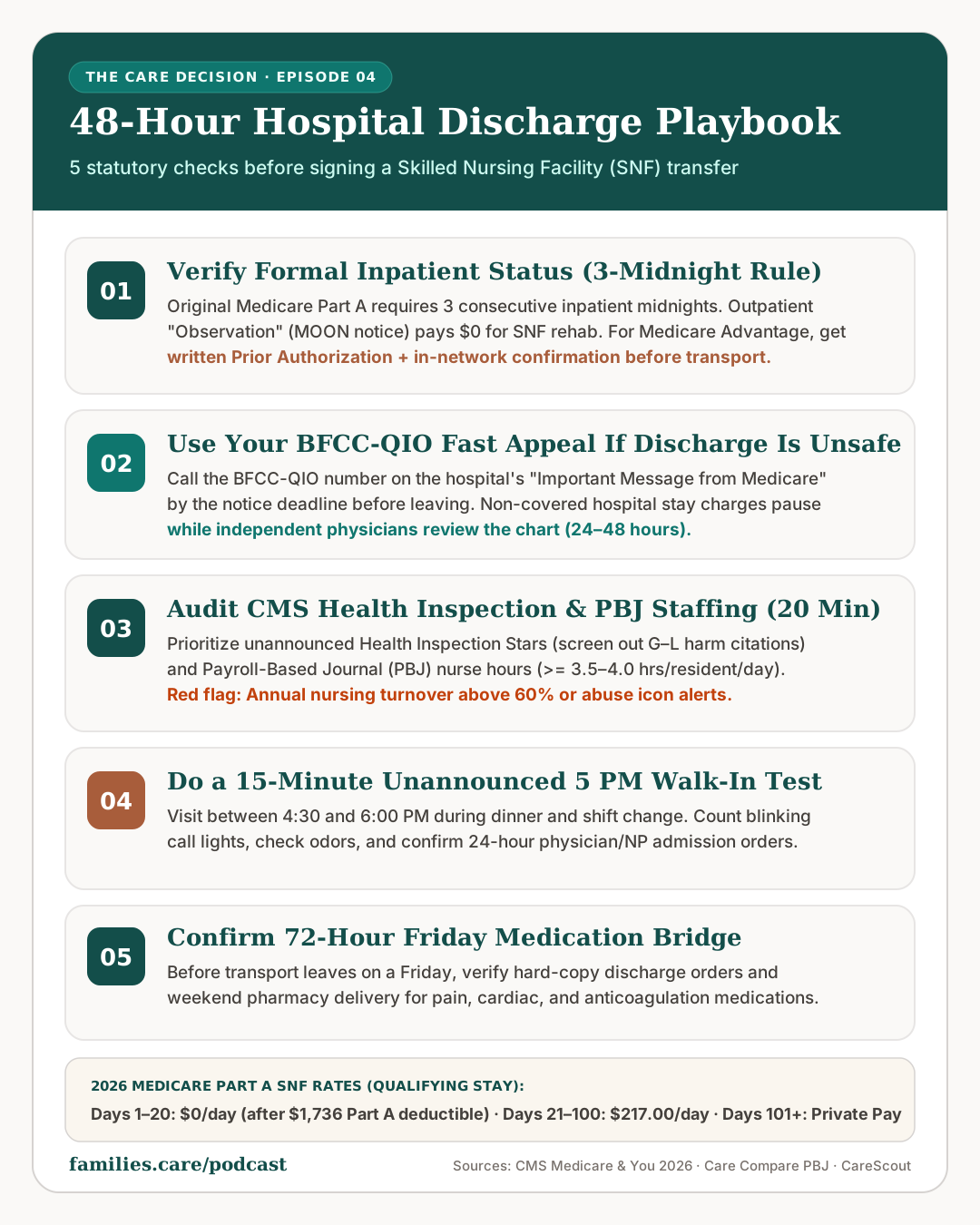
When a hospital discharge planner hands your family a list of five skilled nursing facilities on a Thursday afternoon with 48 hours to choose, panic sets in. In Episode 4, Maya and Daniel walk through the exact hospital discharge survival playbook: (1) The 3-Midnight Inpatient Trap: why hospital observation status voids Medicare Part A rehab coverage entirely ($0 paid by Medicare; leaving families with $9,581+/mo nursing home bills), (2) The MOON Notice & Medicare Advantage prior auth rules, (3) The BFCC-QIO Fast Appeal: how calling the phone number on the Important Message from Medicare by the notice deadline before leaving the hospital triggers an independent medical review (pausing non-covered inpatient hospital charges while standard Medicare deductibles and coinsurance may still apply), (4) CMS Five-Star Vetting in 20 Minutes: why to prioritize unannounced Health Inspection Stars (and G–L harm citations) and PBJ RN staffing hours/turnover over self-reported Quality Measures, (5) The 5 PM Shift-Change Walk-In Test and Friday pharmacy rule, and (6) The 5-Step Survival Checklist.
Jump to chapter:
-
EPISODE 03 · AUDIO Funding ⏱ 10:09 PublishedRate
Episode 3: How Families Actually Pay for Assisted Living & Memory Care: The Six Doors
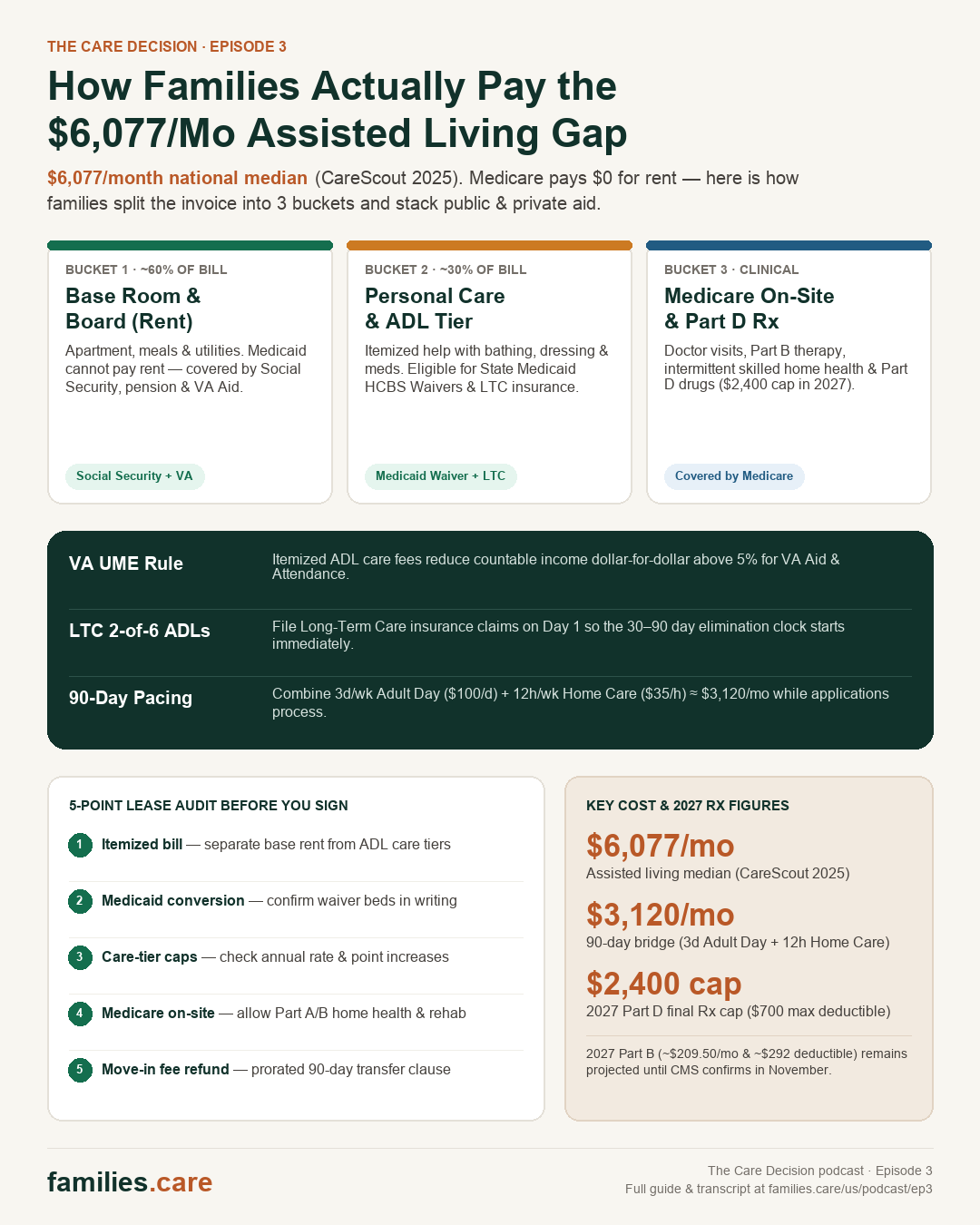
If the national median for assisted living is $6,200 a month and the average retired worker's Social Security check in 2026 is $2,071 a month, there is a $4,000+ monthly gap appearing on the kitchen table every 30 days. In Episode 3, Maya and Daniel explain why no single program pays the whole invoice — and how splitting your community's quote into 3 separate legal buckets (Bucket 1: Room & Board, Bucket 2: Personal Care Tier, Bucket 3: Medical & Clinical Care) unlocks the Six Funding Doors: (1) Social Security & pensions (including the 3.6% 2027 COLA), (2) Long-Term Care Insurance (2-of-6 ADL triggers & 90-day elimination clocks), (3) VA Aid & Attendance tax-free cash ($1,558–$2,874/mo), (4) State Medicaid HCBS Assisted Living Waivers (why Medicaid never pays Room & Board and why 12–24 month private-pay rules matter), (5) Home equity & bridge financing, and (6) Life settlements & the IRS Sec. 213(d) medical expense deduction.
Jump to chapter:
-
EPISODE 02 · AUDIO Care types ⏱ 19:21 PublishedRate
Episode 2: What Does Memory Care Actually Cost?
There is no official national price for memory care. The benchmark survey everyone cites — the CareScout Cost of Care Survey — publishes a national median for assisted living ($6,200 a month in the 2025 survey) and does not survey memory care separately. What families actually pay is a local base rate, plus a premium for the secured memory care floor, plus a stack of assessed charges on top. In this episode, Maya and Daniel walk through the whole stack: the base rate and the premium (assisted living's $6,200 national median; memory care typically 20–30% above the same community's assisted living rate — A Place for Mom's 2026 medians imply about 23%, private data, labeled as such); why geography swamps every national number (medians from roughly $4,400/month in Mississippi to about $9,600 in Massachusetts and around $12,000 in Hawaii); the ten price movers (care tier and reassessment, medication management, incontinence care, mobility and transfers, help with daily activities; the secured unit itself, apartment choice, and pricing model — all-inclusive vs à la carte; move-in fee, annual increases, and length of stay multiplying all of it); a worked example on published figures only ($6,690/month becomes $80,280 for one year and $160,560 for twenty-four months, before assessed tier and medication lines); what doesn't pay (Medicare does not cover long-term custodial care, and GUIDE's respite help does not reach memory care residents — memory care unit residents are not GUIDE-eligible as of July 2026); and a five-question checklist to ask any memory care community before signing, ending with the two-year total at the next tier up.
Jump to chapter:
-
EPISODE 01 · AUDIO Funding ⏱ 6:18 PublishedRate
Episode 1: Your Parent's Medicare Plan Is Ending. Now What?
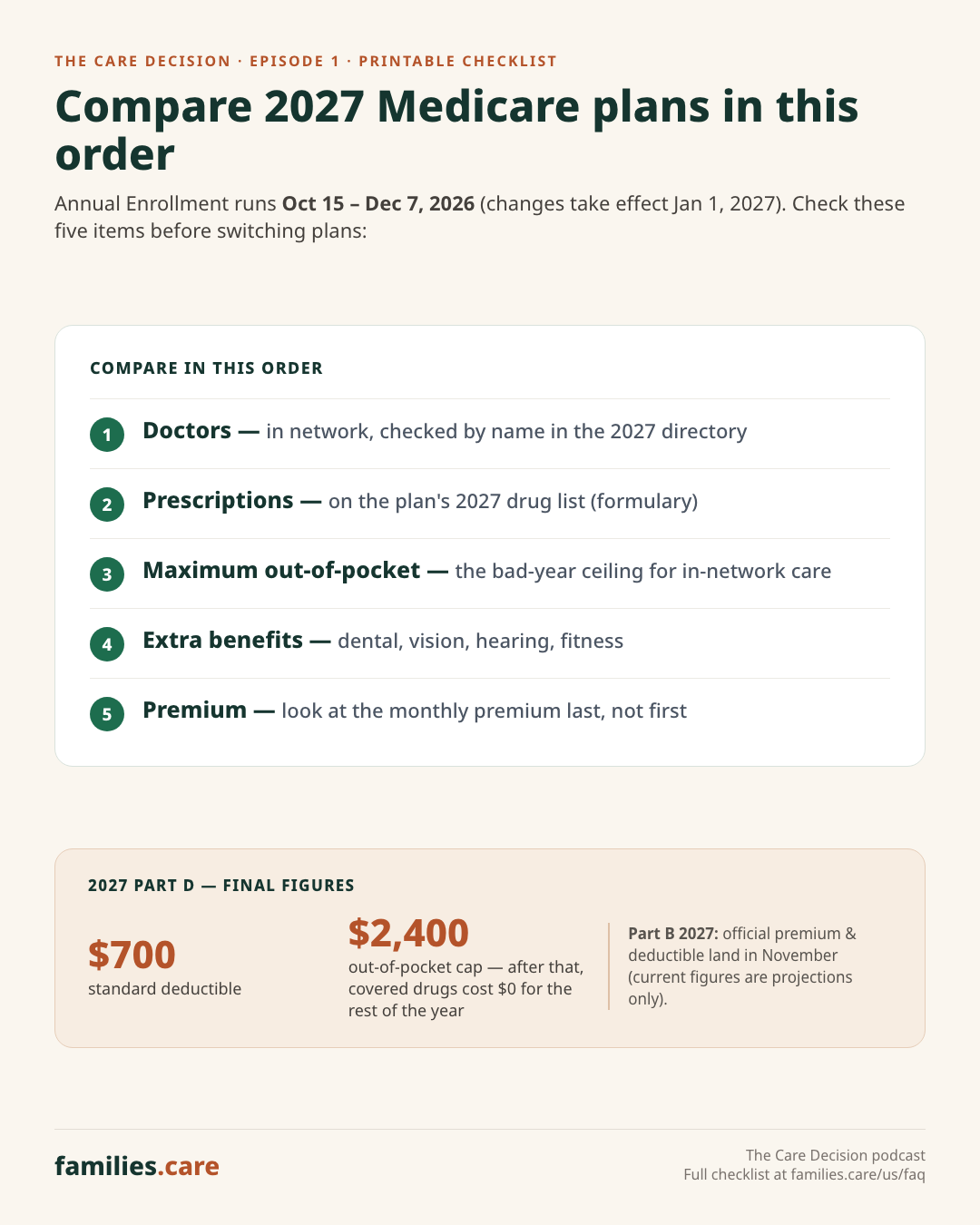
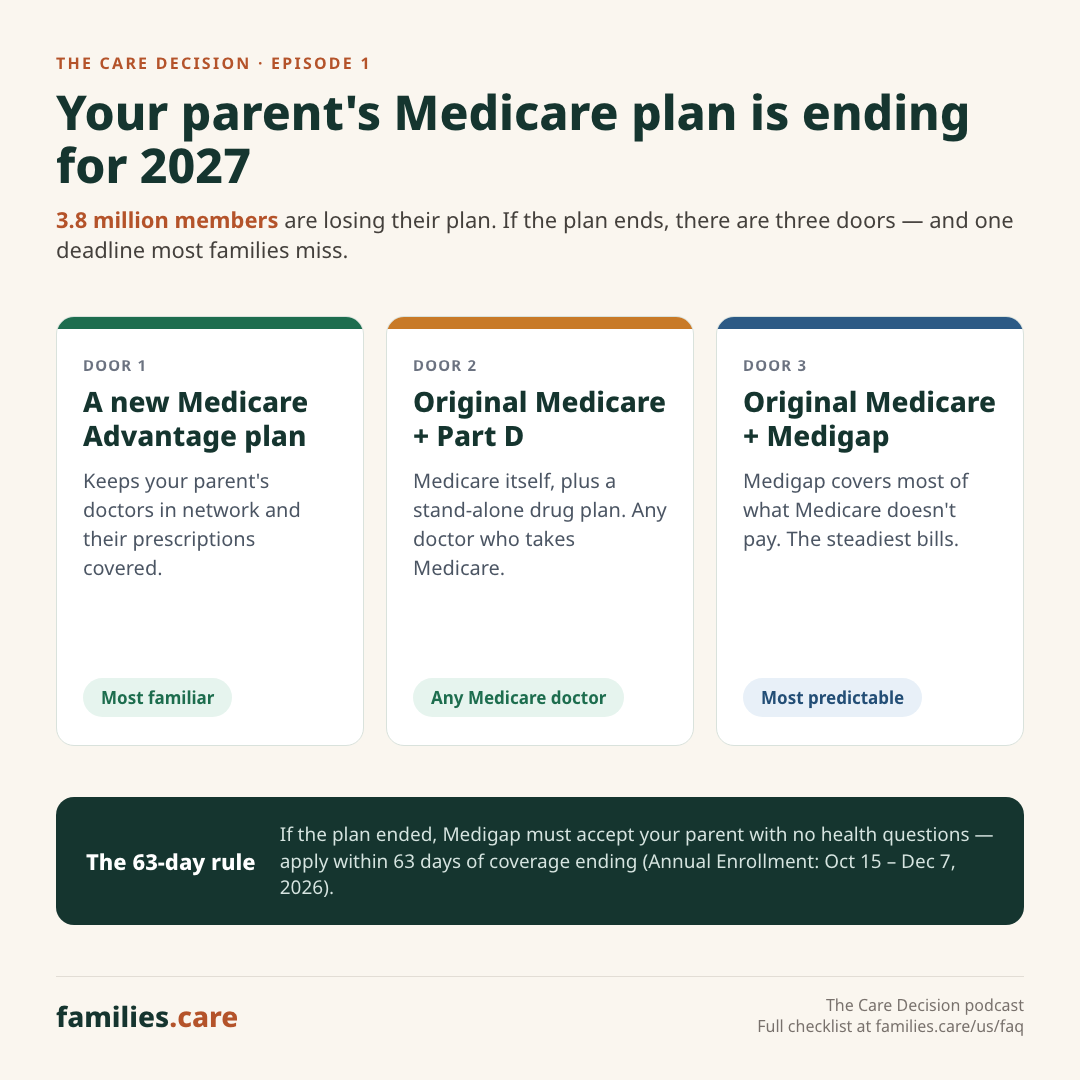
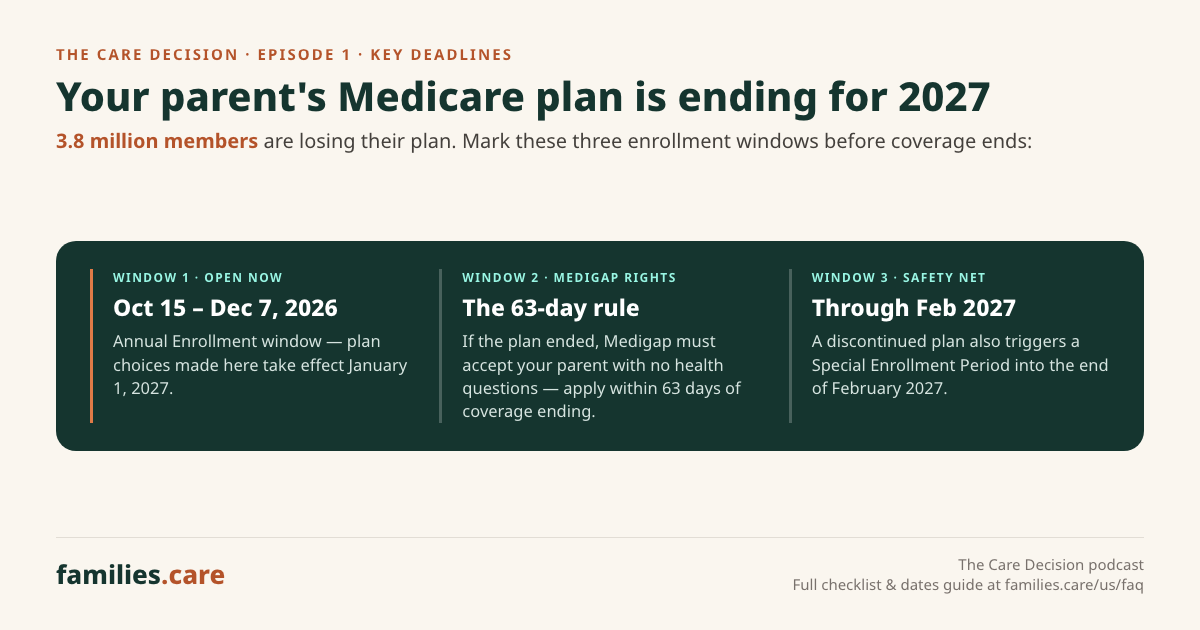
Roughly 3.8 million people on Medicare are losing their current health plan for 2027 — insurers are leaving counties, ending contracts, or not renewing plans. If your parent got a thick letter from their insurance company in September and set it aside, that letter may be telling them their coverage ends December 31.
Jump to chapter:
Printable Family Reference Cards & Checklists
Designed for families to use during insurer calls, facility tours, and kitchen-table planning. Tap any reference card to open it full screen.
5-Step Plan Comparison Checklist
The Three Doors Reference Card
Key Deadlines Timeline (2026–2027)
Assisted Living vs. Memory Care Cost Breakdown
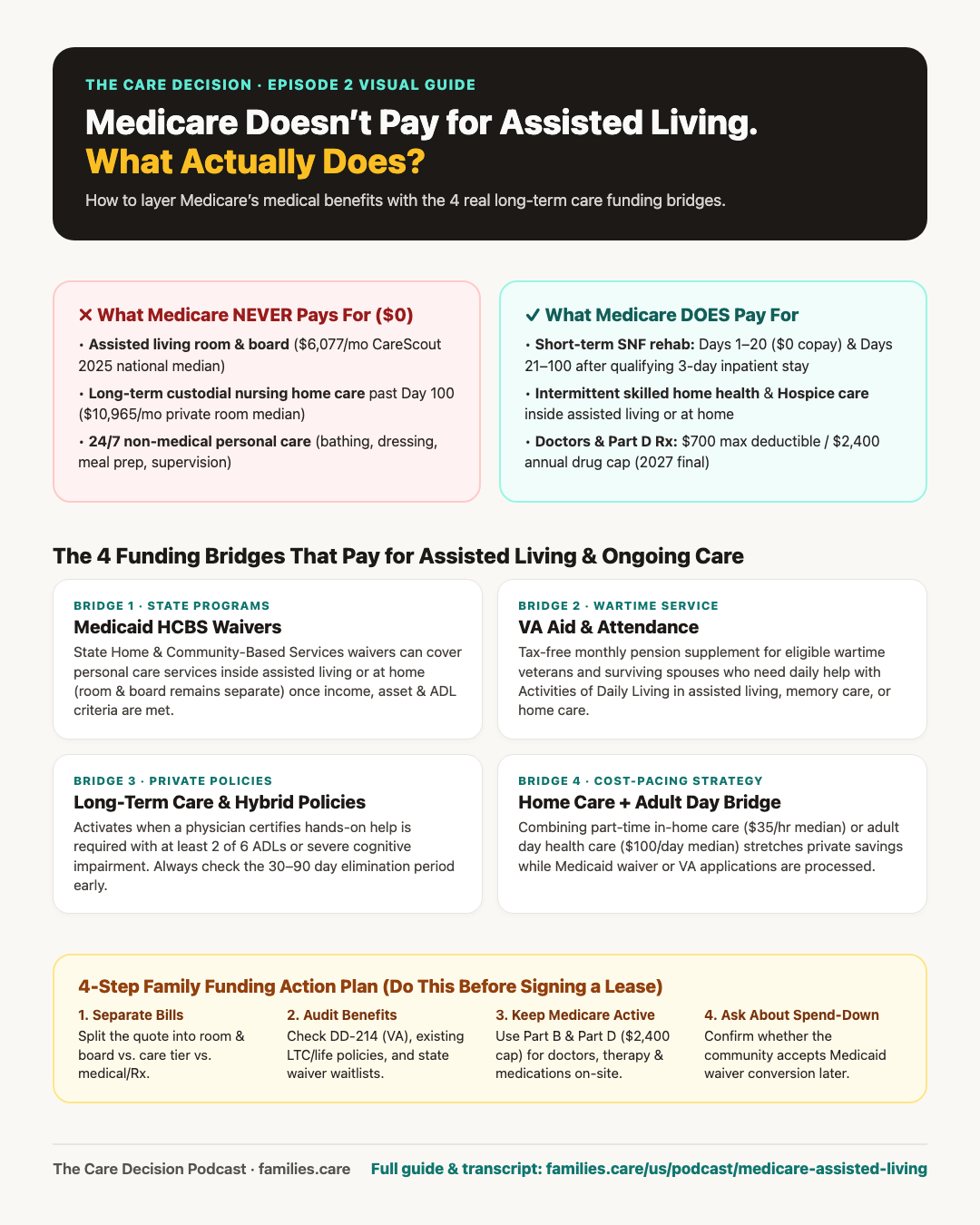
How Families Pay the Monthly Care Gap
48-Hour Hospital Discharge & SNF Survival Playbook
Turn This Episode Into Your Local Plan
National averages only tell half the story. Check the exact figures, Medicaid waiver rules, and verified communities in your parent’s state and city.
Cost Calculator
Compare Local Care Costs by State & City
See CareScout 2025 assisted living medians and estimated memory care rates in your area.
Provider Directory
Search Verified Local Communities
Filter assisted living, memory care, and skilled nursing near your parent’s ZIP or city.
State & Federal Guides
Medicare, Medicaid & Care Checklists
Step-by-step written guides grounded in CMS rules and state Medicaid statutes.