
El alta hospitalaria en 48 horas y evaluación de centros SNF con CMS 5 Estrellas
Cuando el planificador de alta hospitalaria entrega una lista de cinco centros de enfermería (SNF) con 48 horas para elegir, tres trampas pueden costar miles de dólares.
Este episodio en inglés utiliza voces generadas con IA. El guion fue investigado, redactado y verificado por el equipo editorial de families.care con fuentes oficiales de CMS, SSA y CareScout.
Leer guía escrita complementaria en Español →
El alta hospitalaria en 48 horas y evaluación de centros SNF con CMS 5 Estrellas
Escuche abajo en inglés con subtítulos o salte directamente a cualquier capítulo.
Saltar a capítulo (toque la marca de tiempo para ir al audio y actualizar enlace #t=):
Puntos clave
- 01Regla de 3 medianoches de internación: la cobertura SNF de Medicare Parte A exige 3 medianoches consecutivas como paciente internado; el estado de observación paga $0 en rehabilitación.
- 02Coseguro SNF de Medicare Parte A 2026: Días 1–20: $0/día (tras el deducible de $1,736 por período de beneficios si aplica); Días 21–100: $217.00/día; Días 101+: 100% pago privado (mediana de $9,581/mes semiprivado).
- 03Medicare Advantage: suele exonerar las 3 medianoches pero exige autorización previa estricta y redes estrechas de centros SNF.
- 04Apelación rápida BFCC-QIO: llame al BFCC-QIO dentro del plazo indicado en el aviso hospitalario antes de salir del hospital; se pausan cargos hospitalarios no cubiertos durante la revisión médica, aunque pueden aplicar deducibles y coseguros habituales.
- 05Auditoría SNF en 20 minutos: verifique estrellas de Inspección de Salud (e infracciones G–L) y horas de enfermería PBJ por nómina (más del 60% de rotación es señal de alerta).
- 06Prueba sorpresa en cambio de turno: visite entre 4:30 y 6:00 PM durante la cena y cambio de guardia para contar timbres sin respuesta, y asegure suministro de medicación de 72 horas.
Planificación del alta y comparación de centros de enfermería especializada
Prepare preguntas sobre la cobertura y compare los datos de dos centros SNF. Esta hoja registra la información que usted ingresa; no verifica la cobertura ni determina si un traslado es seguro.
Centro A (Lista del hospital)
Centro B (Lista del hospital)
Planificación de cobertura SNF
Medicare Original 2026: días cubiertos 1–20, $0/día; 21–100, $217/día
Estancia indicada por usted; el hospital y el SNF deben confirmar la cobertura y el plan de traslado.
Puntaje orientativo A
81/100 · Datos ingresados más favorables
4★ Inspection · 4.1h PBJ · 38% turnover
Puntaje orientativo B
0/100 · Revisar datos señalados
Mayor puntaje orientativo: Centro de ejemplo A (81 puntos de diferencia)
Importes de Medicare Original 2026 por período de beneficios, solo si cumple los requisitos de cobertura. El deducible de la Parte A de $1,736 se aplica si no se pagó en el mismo período de beneficios. Hasta 100 días cubiertos, no garantizados; desde el día 101 paga todos los costos. Los costos de Medicare Advantage dependen del plan.
Puntaje orientativo de esta hoja, no una calificación de CMS ni una evaluación de seguridad. Los datos iniciales son ejemplos, no registros verificados de centros. Sustitúyalos por datos actuales y consulte al equipo de atención.
Fuentes oficiales: Cobertura y costos de SNF · Apelaciones rápidas

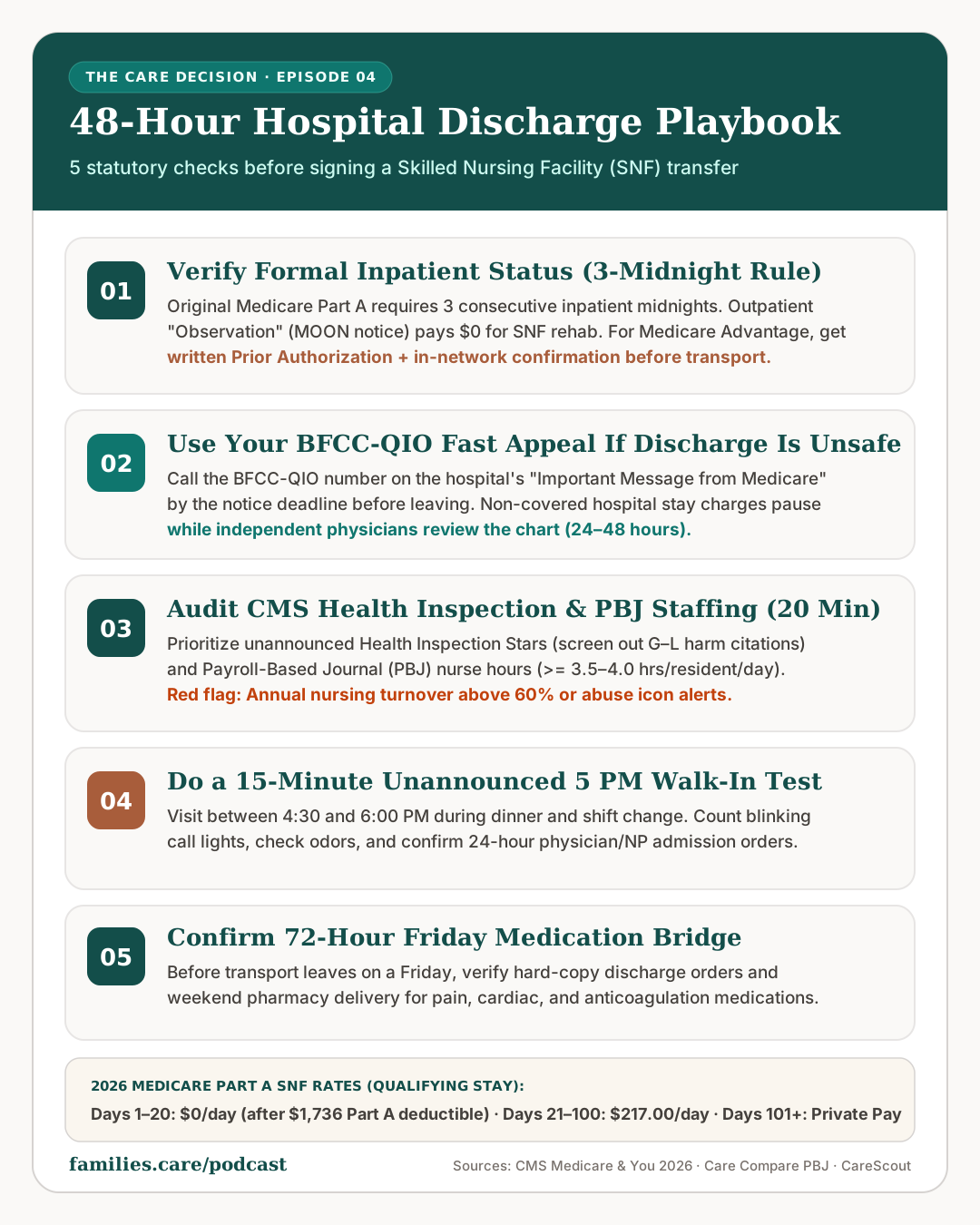
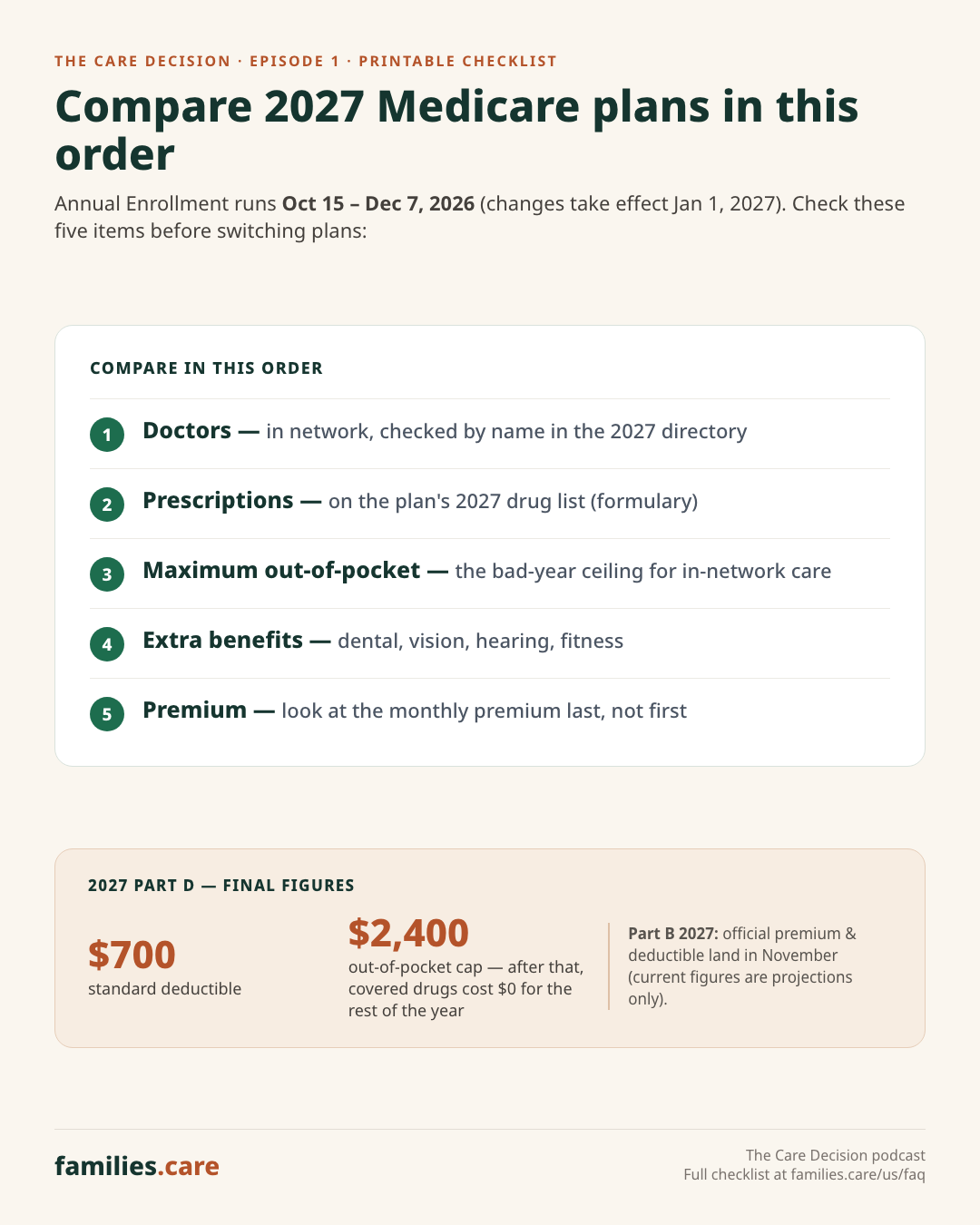
Tarjetas de referencia imprimibles del Episodio 4
Diseñadas para llamadas con aseguradoras, recorridos por residencias y reuniones familiares. Las láminas visuales están en inglés con cifras oficiales verificadas.
Notas del episodio
When a hospital discharge planner hands your family a list of five skilled nursing facilities on a Thursday afternoon with 48 hours to choose, panic sets in. In Episode 4, Maya and Daniel walk through the exact hospital discharge survival playbook: (1) The 3-Midnight Inpatient Trap: why hospital observation status voids Medicare Part A rehab coverage entirely ($0 paid by Medicare; leaving families with $9,581+/mo nursing home bills), (2) The MOON Notice & Medicare Advantage prior auth rules, (3) The BFCC-QIO Fast Appeal: how calling the phone number on the Important Message from Medicare by the notice deadline before leaving the hospital triggers an independent medical review (pausing non-covered inpatient hospital charges while standard Medicare deductibles and coinsurance may still apply), (4) CMS Five-Star Vetting in 20 Minutes: why to prioritize unannounced Health Inspection Stars (and G–L harm citations) and PBJ RN staffing hours/turnover over self-reported Quality Measures, (5) The 5 PM Shift-Change Walk-In Test and Friday pharmacy rule, and (6) The 5-Step Survival Checklist.
Enlaces mencionados en este episodio
Transcripción completa (guion original en inglés)
Guion íntegro de producción reproducido textualmente tal como fue grabado en inglés.
📖 Leer diálogo completo de Maya y Daniel (34 intervenciones) Expandir ↓
Maya: A quick note before we begin. This episode uses A I generated voices. The script was researched, written, and fact checked by the families dot care team, and the figures in it come from official sources.
Daniel: Welcome back to The Care Decision, the families dot care podcast, where we take one real decision that families face with an aging parent, and we answer it all the way through. I am Daniel.
Maya: And I am Maya. Today we are tackling the single highest-pressure 48 hours in senior care: when a hospital discharge planner walks into your parent's room on a Thursday afternoon, hands you a photocopied list of five skilled nursing facilities, and says your parent has to leave by Saturday morning.
Daniel: Almost every family in that room feels the same panic. They assume they have no leverage, they assume Medicare automatically pays for the rehab stay, and they pick whichever facility on the photocopy has an open bed five miles from home.
Maya: And all three of those assumptions can cost a family tens of thousands of dollars or put a frail parent into an understaffed building. Today we are walking through the exact playbook for those forty-eight hours: first, the three-midnight inpatient trap that quietly voids Medicare Part A rehab coverage; second, how to trigger an immediate federal discharge appeal when your parent is not safe to leave; and third, how to use C M S Five-Star inspection and staffing data to vet a skilled nursing facility in twenty minutes.
Daniel: Start with trap number one, because families are stunned when they get a skilled nursing bill for ten thousand dollars a month after a hospital stay. Why would Medicare Part A refuse to pay for rehab after a hospital stay?
Maya: Because of one word in the hospital chart: Observation. Under federal law, Section 1861 of the Social Security Act, Original Medicare Part A only covers skilled nursing facility care if the patient had a qualifying inpatient hospital stay of at least three consecutive midnights before discharge. Time spent in the emergency room, or time spent admitted under outpatient observation status, does not count toward those three midnights, even if your parent slept in a hospital bed on the fourth floor for five days and received intravenous medications.
Daniel: Let us make sure everyone hears that clearly. Your parent can be in a hospital gown, in a hospital room, eating hospital food for four nights, and legally Medicare still considers them an outpatient?
Maya: Yes. And if they are discharged to a skilled nursing facility from observation status, or after only two inpatient midnights, Medicare Part A pays zero dollars for the nursing home stay. Remember the CareScout benchmark figures from Episode Two: a semi-private room in a nursing home averages nine thousand five hundred eighty-one dollars a month, and a private room averages ten thousand seven hundred ninety-eight dollars a month.
Daniel: How does a family find out which status their parent is in before the discharge van arrives?
Maya: Ask the hospital case manager or attending physician one direct question on day one: Is my parent admitted as a formal inpatient, or are they under observation status? Hospitals are also required under the federal NOTICE Act to hand families a written Medicare Outpatient Observation Notice, called the MOON form, if a patient has been under observation for more than twenty-four hours. If you see that form, ask the attending doctor whether your parent's clinical condition justifies changing their order to formal inpatient admission before discharge.
Daniel: And what if your parent is on a Medicare Advantage plan instead of Original Medicare?
Maya: Many Medicare Advantage plans waive the three-midnight rule, which sounds helpful, but they replace it with two different hurdles: strict prior authorization before the transfer, and a narrow list of in-network skilled nursing facilities. With Medicare Advantage, never move your parent into a rehab facility until you have the plan's written prior authorization number in your hand.
Daniel: Now let us say the three midnights are met, so Medicare Part A is active. What does Medicare Part A actually pay inside the skilled nursing facility?
Maya: For a qualifying stay in twenty twenty-six, Medicare Part A pays one hundred percent of the approved cost for Days one through twenty. Starting on Day twenty-one through Day one hundred, the patient owes a daily coinsurance of two hundred nine dollars and fifty cents per day unless they have a Medigap supplement policy or secondary coverage that picks it up. After Day one hundred, Medicare Part A stops completely. And one crucial rule: those one hundred days are not automatic. Your parent only keeps Medicare Part A coverage for as long as they need daily skilled nursing or skilled physical, occupational, or speech therapy.
Daniel: Let us move to part two of the playbook. What if the hospital says your parent is ready to be discharged tomorrow, and you look at your parent and know they cannot safely transfer, or the rehab bed is not ready?
Maya: You use your federal statutory right to an immediate expedited discharge appeal. Before discharging any Medicare inpatient, the hospital must deliver a written notice called the Important Message from Medicare. On that page is the phone number for the Beneficiary and Family Centered Care Quality Improvement Organization, or B F C C dash Q I O, for your state.
Daniel: What happens when a family calls that Q I O number before midnight on the day of discharge?
Maya: Everything freezes. As long as you call the Q I O before your parent physically leaves the hospital and before midnight on the planned discharge date, the hospital cannot force your parent out, and you cannot be billed for the extra hospital days while the independent Q I O physicians review the medical chart. That review usually takes twenty-four to forty-eight hours, which often gives a family the vital breathing room they need to secure a safe, four- or five-star rehab bed instead of taking the first facility with an empty mattress.
Daniel: Which brings us to part three: the discharge planner hands you a list of five skilled nursing facilities. Under federal law, the hospital cannot steer you to one provider, so they hand you an alphabetical sheet. How do you separate the safe buildings from the dangerous ones in twenty minutes?
Maya: You ignore the brochure photos and the lobby chandelier, and you look up three numbers from the federal C M S Care Compare database, which we surface directly on every nursing home profile at families dot care. Although C M S gives each building an overall rating from one to five stars, the overall star is a composite. The two numbers that actually predict what your parent's life will feel like at two in the morning are the Health Inspection rating and the Staffing rating.
Daniel: Why is the Health Inspection rating more reliable than the Quality Measures star?
Maya: Because the Health Inspection star is based on unannounced, on-site state survey inspections conducted over the last three years, plus substantiated complaint investigations. Quality Measures are largely self-reported by the facility, whereas health inspection citations are written by state inspectors walking the halls unannounced. Look specifically at whether the building has any abuse icon alerts or High-Severity Harm citations, labeled G, H, I, J, K, or L on the inspection report.
Daniel: And what is the second number families should check on the profile?
Maya: Registered Nurse and total nurse staffing hours per resident per day, plus annual staff turnover. C M S tracks these through electronic payroll records called Payroll-Based Journal data, not facility promises. Specifically, check two things: first, does the facility deliver at least three point five to four total nursing hours per resident per day, including meaningful Registered Nurse coverage on weekends? Second, what is the annual nursing staff turnover percentage? When turnover exceeds sixty percent a year, the aides caring for your parent do not know your parent's baseline, which is how early signs of infection, dehydration, or delirium get missed.
Daniel: If a family member can physically walk into the top two facilities on their list for a fifteen-minute unscheduled visit before signing the admission packet, what should they check?
Maya: Walk in between four thirty and six in the evening, during dinner and shift change, not at ten in the morning when the marketing director has staged the tour. Notice three things in the first five minutes: first, your nose and ears, specifically how many call lights are blinking unanswered down the hallway; second, whether residents are dressed and out of bed or left in gowns in the afternoon; and third, ask the admissions director one clinical question: Will a doctor or nurse practitioner see my parent within twenty-four hours of admission, and how are evening medications ordered if my parent arrives at five P M on a Friday?
Daniel: Because Friday evening admissions are notoriously where pain medications and cardiac prescriptions get delayed over the weekend.
Maya: Exactly. Always ask the hospital to send a hard-copy discharge summary and at least a seventy-two-hour bridge supply or electronic transmission of every medication before the transport leaves the hospital bay.
Daniel: Let us summarize the 5-Step 48-Hour Hospital Discharge Survival Checklist.
Maya: Step one: Confirm your parent's hospital status in writing. Ensure they have three consecutive midnights as a formal inpatient, not observation status, or confirm written prior authorization if they have Medicare Advantage. Step two: If discharge is premature or unsafe, call the B F C C dash Q I O number on the Important Message from Medicare before midnight to freeze the discharge for an independent review. Step three: Screen every facility on your shortlist using C M S Health Inspection stars, weekend R N staffing hours, and staff turnover at families dot care. Step four: Do a fifteen-minute unscheduled visit during the late afternoon shift change and count unanswered call lights. And step five: Never allow a Friday afternoon transfer without confirming weekend pharmacy delivery and an initial physician order set.
Daniel: Our printable 48-Hour Hospital Discharge Survival Checklist, our 5-Step Coverage Comparison Card, and our interactive US Hospital Discharge Planner are all free at families dot care slash u s slash hospital dash discharge.
Maya: That is Episode Four of The Care Decision. One real decision, answered all the way through. I am Maya.
Daniel: And I am Daniel. Thanks for listening, and check that inpatient status before you sign.
Todos los episodios en audio de la serie
Cada episodio responde una decisión concreta sobre cuidado y cobertura en menos de 20 minutos, con el mismo formato limpio y herramientas interactivas.
-
EPISODIO 01 ⏱ 6:18 · Financiamiento
El plan de Medicare de sus padres termina. ¿Qué hacer ahora?
Cerca de 3.8 millones de beneficiarios de Medicare perderán su plan actual para 2027 porque las aseguradoras salen de ciertos condados o no renuevan contratos.
-
EPISODIO 02 ⏱ 19:21 · Tipos de cuidado
¿Cuánto cuesta realmente el cuidado de la memoria?
No existe una tarifa nacional oficial para cuidado de la memoria: las familias pagan una tarifa base local (mediana nacional de $6,200/mes en vida asistida según CareScout 2025), más un recargo de 20%–30% por unidad segura de memoria, más los cargos por nivel de cuidado, manejo de medicamentos e incontinencia.
-
EPISODIO 03 ⏱ 10:09 · Financiamiento
Cómo cubren las familias la brecha mensual en vida asistida: las seis puertas
Divide la factura mensual de vida asistida o memoria en tres rubros (Alojamiento, Cuidado Personal y Atención Clínica) para acceder a las Seis Puertas de Financiamiento: Seguro Social, Seguro de Cuidado a Largo Plazo, VA Aid & Attendance (hasta $2,874/mes en efectivo libre de impuestos), exenciones HCBS de Medicaid, patrimonio de la vivienda y deducción médica según el Art.
-
EPISODIO 04 ⏱ 10:19 · Hospital y rehabilitación
El alta hospitalaria en 48 horas y evaluación de centros SNF con CMS 5 Estrellas
Cuando el planificador de alta hospitalaria entrega una lista de cinco centros de enfermería (SNF) con 48 horas para elegir, tres trampas pueden costar miles de dólares.
🎧 Escuchando ahora · Episodio 4 -
EPISODIO 05 ⏱ 7:49 · Tipos de cuidado
Stay Home or Move? The Home Care vs. Assisted Living Decision
Episode Five answers the question that comes before every other episode in this series: not what a care setting costs, and not how to pay for it, but which setting — care brought into your parent's home, or a move to assisted living.
-
EPISODIO 06 ⏱ 6:48 · Tipos de cuidado
¿Cuidar en casa o buscar una residencia? La decisión en familia
En este primer episodio en español de La Decisión del Cuidado, Maya y Daniel responden la decisión que enfrentan las familias en toda América Latina: seguir cuidando en casa, entre la familia y ayuda contratada, o buscar una residencia privada para adultos mayores.
-
EPISODIO 07 ⏱ 7:12 · Tipos de cuidado
Choosing a Care Home in England: Check the Rating, Then Check Who Pays
This episode answers the care home decision for England in the order that protects families: assessment first, rating second, funding third, contract last.
-
EPISODIO 08 ⏱ 6:19 · Tipos de cuidado
Home or Residential Care? Australia's New Aged Care System Starts With One Assessment
This episode answers Australia's version of the care decision — stay home with Support at Home, or move into residential aged care — inside the system that replaced the old one.
-
EPISODIO 09 ⏱ 6:24 · Tipos de cuidado
Retirement Home or Long-Term Care Home? Ontario's Two Doors
This episode answers the Canadian version of the care decision using Ontario as the worked example — and says plainly that health care is provincial, so other provinces run the same two-door shape with different names, rates and queues.
¿Le resultó útil este episodio para la decisión de su familia?
Valoración anónima de 1 a 5 estrellas · Ayuda a otras familias a priorizar las mejores guías.
Convierta este episodio en un plan local
Los promedios nacionales solo cuentan la mitad. Consulte las tarifas reales, exenciones estatales de Medicaid y residencias verificadas en el estado y ciudad de sus padres.
Calculadora de costos
Comparar costos por estado y ciudad
Consulte medianas CareScout 2025 de vida asistida y estimaciones de cuidado de la memoria.
Directorio verificado
Buscar residencias y agencias locales
Filtre vida asistida, cuidado de la memoria y enfermería especializada por código postal.
Guías estatales y federales
Listas de Medicare, Medicaid y cuidado
Guías paso a paso basadas en reglas oficiales de CMS y programas estatales.